
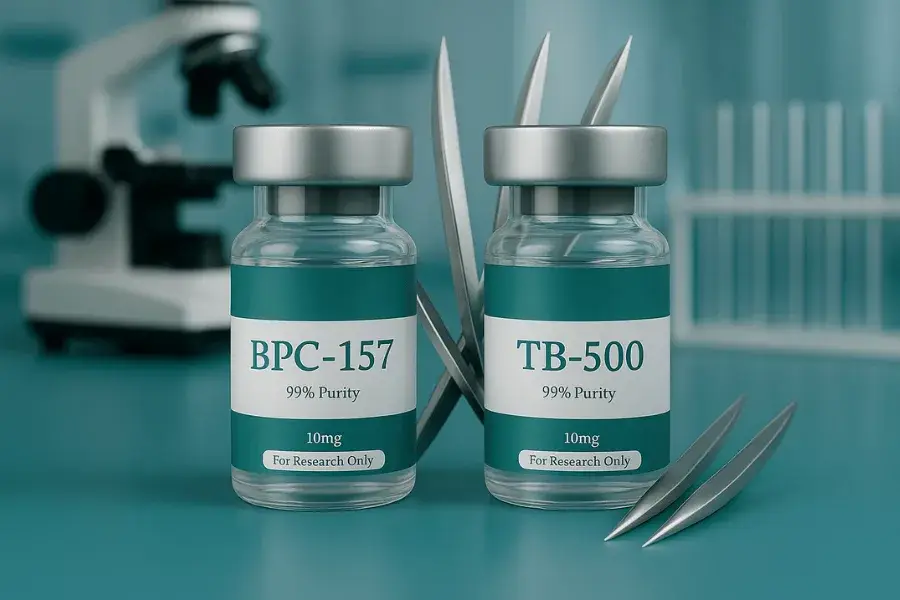
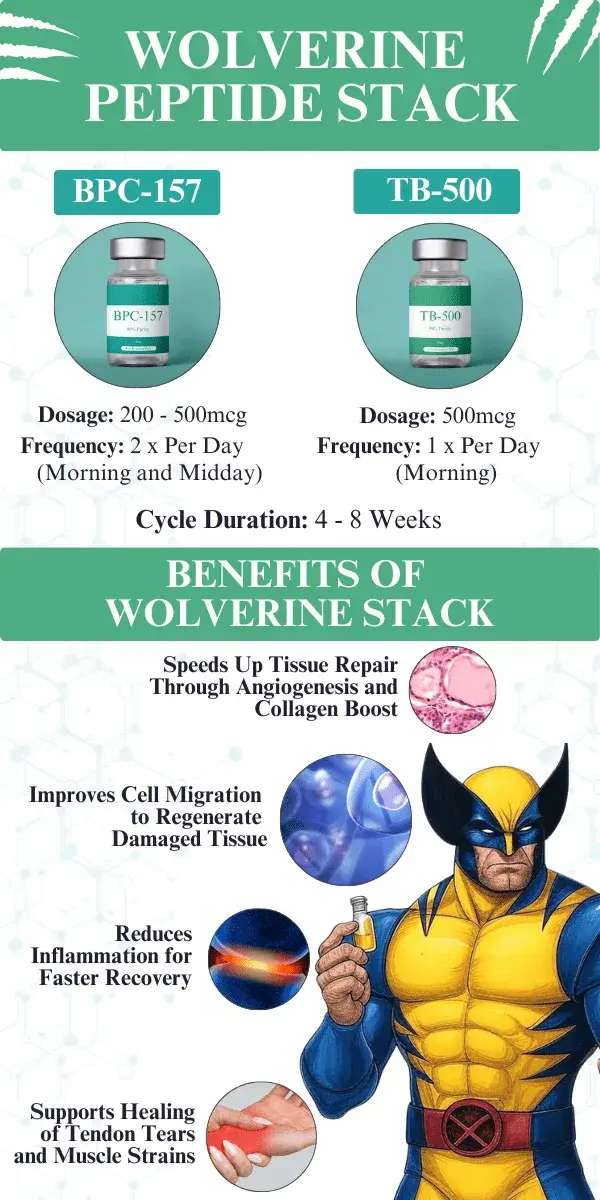
The Wolverine peptide stack is a popular name for combining BPC-157 and TB-500, two experimental peptides associated with tissue repair and recovery research.
Interest in the combination comes largely from preclinical studies examining BPC-157, thymosin beta-4, and related biological pathways involved in tendon healing, cell migration, angiogenesis, and tissue remodeling. However, research on the individual compounds should not be confused with evidence for the Wolverine Stack itself.
Controlled human research on the BPC-157 and TB-500 combination remains extremely limited. There is currently no FDA-approved Wolverine Stack treatment, standardized clinical protocol, or established human dosing regimen.
Key Takeaways
- The “Wolverine peptide stack” refers to the combination of BPC-157 and TB-500, two peptides studied for their potential role in tissue repair and recovery.
- BPC-157 may support healing in muscles, tendons, ligaments, and the gastrointestinal system, partly through mechanisms like angiogenesis and reduced inflammation.
- TB-500 (a synthetic version of thymosin beta-4) may promote cell migration and tissue regeneration, helping repair cells reach injured areas more efficiently.
- Together, these peptides are often discussed for musculoskeletal recovery, particularly in research related to tendon injuries, muscle strains, and post-surgical healing.
What Is the Wolverine Peptide Stack?
The Wolverine Stack generally refers to BPC-157 combined with TB-500.
The nickname comes from the fictional character Wolverine and his ability to heal rapidly. In peptide research, the name is used to describe a combination marketed around recovery, connective tissue, muscle, tendon, and wound-healing interests.
There is no standardized medical definition of the Wolverine Stack. Products and protocols marketed under the name can vary, which makes it especially important to distinguish commercial claims from the published evidence.
BPC-157 and TB-500 also have different research histories. BPC-157 has been investigated extensively in animal and laboratory models, while much of the research frequently associated with TB-500 actually involves the larger peptide thymosin beta-4.
BPC-157 vs. TB-500 at a Glance
| Feature | BPC-157 | TB-500 |
|---|---|---|
| Peptide type | Synthetic 15-amino-acid peptide | Peptide fragment associated with thymosin beta-4 |
| Main research areas | Tendon, ligament, muscle, wound and gastrointestinal models | Cell migration, actin biology and tissue-repair research |
| Human evidence | Very limited | Very limited for TB-500 itself |
| Musculoskeletal evidence | Primarily animal and laboratory research | Much evidence is derived from broader thymosin beta-4 research |
| FDA-approved for injury recovery | No | No |
| Evidence for combined use | No robust controlled human evidence | No robust controlled human evidence |
What Is BPC-157?
BPC-157 is a synthetic peptide composed of 15 amino acids. It has attracted attention because of experimental research involving tendon, ligament, muscle, gastrointestinal tissue, blood vessels, and wound healing.
One laboratory study found that BPC-157 increased the migration and spreading of tendon fibroblasts and influenced FAK-paxillin signaling, a pathway involved in cell adhesion and movement.[2]
Animal research has also examined BPC-157 during muscle and tendon healing. One study reported changes in VEGF expression and angiogenesis during tissue repair in treated animals.[3]
These findings help explain why BPC-157 is frequently discussed in recovery-focused peptide research. They do not, however, establish the same effects in humans.
A 2025 systematic review identified 36 studies relevant to BPC-157 in orthopedic sports medicine. Of those, 35 were preclinical and only one involved human subjects. The review also found no adequate clinical safety data.[1]
What Is TB-500?
TB-500 is commonly discussed alongside thymosin beta-4, a naturally occurring peptide involved in actin regulation and cellular migration.
They are related, but they are not identical.
Analytical research examining material sold as TB-500 identified it as the N-terminal acetylated 17-23 fragment of human thymosin beta-4, with the sequence Ac-LKKTETQ.[4]
This distinction matters when evaluating claims about TB-500. A substantial amount of research commonly cited in discussions of TB-500 actually investigated full-length thymosin beta-4.
Thymosin beta-4 research can help explain why TB-500 has attracted interest in wound repair and cell migration, but findings involving the full peptide cannot automatically establish the same potency, duration, pharmacokinetics, safety, or clinical effects for the shorter TB-500 fragment.
For that reason, direct TB-500 evidence should be considered separately from the larger thymosin beta-4 literature.
Why Are BPC-157 and TB-500 Combined?
The rationale behind the Wolverine Stack comes from the different biological processes associated with each peptide.
BPC-157 research has explored fibroblast migration, vascular signaling, angiogenesis, tendon repair, and inflammatory pathways. Thymosin beta-4 research has focused on actin regulation, cell migration, wound biology, and tissue remodeling.
Those separate areas of research have led to the theory that using the compounds together could influence several aspects of tissue repair at the same time.
The idea remains largely theoretical.
There is not a strong body of controlled human research demonstrating that BPC-157 and TB-500 produce a synergistic effect when combined. Research showing an effect from one peptide also does not establish that adding the second peptide will strengthen that effect.
Has the Wolverine Stack Itself Been Studied?
This is one of the most important distinctions when evaluating the Wolverine Stack.
There is considerably more research on BPC-157, thymosin beta-4, and individual biological pathways than there is on the actual BPC-157 and TB-500 combination.
Published research has not established a clinically validated ratio between the two peptides, a standardized treatment duration, or whether combining them produces better outcomes than using either compound individually.
There is also insufficient controlled human evidence to determine whether the two compounds interact in ways that alter safety, metabolism, or biological activity.
The evidence for the Wolverine Stack should therefore not be represented simply by adding together every study published on BPC-157 and thymosin beta-4.
How Could the Wolverine Stack Affect Tissue Repair?
The scientific interest in these peptides centers on several processes involved in tissue repair.
Fibroblast Migration
Fibroblasts help produce and organize the extracellular matrix during repair.
Experimental research found that BPC-157 increased tendon fibroblast migration and spreading while affecting FAK and paxillin activation.[2]
This provides a possible mechanism for some of the tendon-healing findings reported in preclinical studies.
Angiogenesis
New blood-vessel development is an important part of normal tissue repair because healing tissue requires oxygen and nutrients.
Animal research involving BPC-157 has reported changes in VEGF expression and angiogenesis during muscle and tendon healing.[3]
These findings relate to experimental injury models and do not establish that BPC-157 improves vascular healing or recovery outcomes in people.
Cell Migration and Actin Regulation
Thymosin beta-4 has a well-established relationship with actin, a structural protein involved in cell movement and organization.
TB-500 contains a fragment associated with thymosin beta-4, which is one reason it has become linked to tissue-repair research. Direct research on TB-500 itself is considerably more limited than the broader thymosin beta-4 literature.
Inflammation and Tissue Remodeling
Both BPC-157 research and studies involving thymosin-related pathways have examined inflammatory signaling and tissue remodeling.
These findings provide possible mechanisms for continued research, but they do not establish the Wolverine Stack as an anti-inflammatory treatment or regenerative therapy in humans.
What Are the Proposed Benefits of the Wolverine Stack?
The Wolverine Stack is commonly promoted for tendon recovery, ligament injuries, muscle repair, joint problems, wound healing, and faster recovery after physical activity.
The strength of evidence differs substantially across those claims.
Tendon and Ligament Research
BPC-157 has one of its stronger preclinical research bases in tendon and ligament models.
Laboratory and animal studies have reported effects involving fibroblast migration, tissue organization, functional recovery, and angiogenesis. The research remains predominantly preclinical.
There is not enough controlled human evidence to conclude that the Wolverine Stack accelerates tendon or ligament healing in people.
Muscle Recovery
BPC-157 has also been investigated in animal models of muscle injury, including research examining vascular responses during tissue healing.
Evidence that TB-500 adds a measurable benefit to BPC-157 in human muscle recovery has not been established.
Wound Healing
Thymosin beta-4 has been studied extensively in relation to cellular migration and wound biology.
Because TB-500 is associated with a thymosin beta-4 fragment, this research is frequently used to explain interest in TB-500. However, results from studies of full-length thymosin beta-4 cannot automatically be attributed to TB-500.
Exercise Recovery
There is currently little direct clinical evidence showing that the Wolverine Stack improves routine exercise recovery, reduces normal post-exercise soreness, or allows athletes to return to training faster.
Claims in these areas are often based on extrapolation from injury models or anecdotal reports.
Is the Wolverine Peptide Stack Effective?
There is not enough controlled human research to determine whether the Wolverine Stack is an effective treatment for musculoskeletal injuries.
BPC-157 has produced interesting findings in animal and laboratory models. The 2025 systematic review found promising preclinical results involving muscle, tendon, ligament, and bone injuries, but human evidence remained extremely limited.[1]
The evidence becomes even less certain when BPC-157 is combined with TB-500 because robust human studies of the combination are lacking.
The most accurate interpretation is that the Wolverine Stack has a research rationale, but its effectiveness as a combined human therapy has not been established.
How Long Does the Wolverine Stack Take to Work?
There is no clinically established timeframe for Wolverine Stack results.
Commercial providers and anecdotal reports sometimes describe changes within days or weeks. Those timelines are not supported by controlled clinical trials of the BPC-157 and TB-500 combination.
Preclinical studies may observe biological changes over relatively short experimental periods, but animal and cell-study timelines cannot reliably predict how quickly a compound would affect an injured human tendon, ligament, or muscle.
The type and severity of an injury, natural healing time, rehabilitation, overall health, and many other factors can also influence recovery.
Is There an Established Wolverine Stack Dosage?
There is no standardized, FDA-approved, or clinically validated human dosage for the Wolverine Stack.
Protocols published online often specify particular amounts of BPC-157 and TB-500, injection frequencies, loading phases, or cycle lengths. These approaches have not been established as standard clinical dosing through controlled human trials.
Animal-study doses also cannot simply be converted into human recommendations because differences in metabolism, exposure, formulation, route of administration, and study design affect how experimental findings translate between species.
There is therefore no evidence-based “best Wolverine Stack protocol” established by clinical research.
Wolverine Stack Safety and Side Effects
Human safety information is one of the biggest gaps in Wolverine Stack research.
The 2025 systematic review of BPC-157 found no adequate clinical safety data, even though animal studies did not identify major adverse effects across several experimental systems. The authors also noted potential risks related to unregulated manufacturing, contamination, and unknown clinical safety.[1]
Human safety information for TB-500 is also limited.
Combining two experimental peptides creates additional unanswered questions. Researchers do not yet have a strong clinical evidence base showing whether combined use changes metabolism, biological activity, immune responses, or adverse-effect risk.
The absence of well-documented side effects should therefore not be interpreted as proof that the combination is safe.
Are BPC-157 and TB-500 FDA Approved?
Neither BPC-157 nor TB-500 is FDA approved as a treatment for tendon injuries, ligament injuries, muscle recovery, wound healing, or other regenerative uses.[5]
In July 2026, the FDA’s Pharmacy Compounding Advisory Committee considered BPC-157-related and TB-500-related bulk drug substances for possible inclusion on the Section 503A Bulks List. BPC-157 was reviewed in relation to ulcerative colitis, while TB-500 was reviewed in relation to wound healing.[5]
A compounding review is separate from the drug-approval process. It does not mean that either peptide has been shown to be safe and effective for the recovery uses commonly associated with the Wolverine Stack.
Are BPC-157 and TB-500 Banned in Sports?
Competitive athletes should pay particular attention to anti-doping rules.
BPC-157 has been listed by the World Anti-Doping Agency as a prohibited non-approved substance. Thymosin beta-4 and its derivatives, including TB-500, are also included within prohibited growth factors and growth-factor modulators.[6]
WADA-supported research has specifically investigated the metabolism and detection of TB-500 in biological samples.[7]
Athletes subject to anti-doping regulations should check the current WADA Prohibited List and the rules of their governing organization rather than relying on product labels or “research use” descriptions.[6]
How Much Does a Wolverine Peptide Stack Cost?
There is no standard price for a Wolverine Stack.
The name may refer to separate peptide products, premixed research materials, compounded preparations, or clinic programs that include consultations and additional services.
Those options are not equivalent, so prices can vary substantially. Price also provides little information about identity, purity, sterility, or whether a product matches material used in published research.
Wolverine Stack vs. BPC-157 or TB-500 Alone
Using BPC-157 and TB-500 together does not automatically make the combination more effective.
BPC-157 has a larger body of preclinical musculoskeletal research. Direct evidence for TB-500 itself is considerably more limited, and many claims associated with TB-500 originate from studies of full-length thymosin beta-4.
The Wolverine Stack introduces another level of uncertainty because the combination has not been studied nearly as extensively as the individual research areas used to justify it.
When evaluating the evidence, it helps to keep four categories separate: BPC-157 research, direct TB-500 research, full-length thymosin beta-4 research, and studies of the BPC-157 plus TB-500 combination. Findings in one category do not automatically establish the same result in another.
What Are the Main Research Limitations?
The Wolverine Stack has several significant evidence gaps.
Most BPC-157 musculoskeletal research comes from animals and laboratory models, while controlled human evidence remains sparse. Direct research on TB-500 is also limited compared with the broader literature on full-length thymosin beta-4.
Most importantly, there is no substantial body of controlled human research evaluating BPC-157 and TB-500 together. This means researchers do not yet have validated data establishing an ideal ratio, treatment duration, long-term safety profile, or whether the combination is actually more effective than either compound alone.
These limitations are important when interpreting claims about rapid recovery, tissue regeneration, or synergistic effects.
Frequently Asked Questions
What peptides are in the Wolverine Stack?
The Wolverine Stack usually refers to BPC-157 and TB-500. The term is informal rather than a standardized clinical formulation, so commercial products may differ.
Is the Wolverine peptide stack good?
There is not enough controlled human evidence to determine whether the Wolverine Stack is an effective treatment for injury recovery. The scientific rationale is based mainly on preclinical research involving BPC-157 and thymosin-related pathways.
How long does the Wolverine Stack take to work?
No clinically established timeline exists. Specific claims about results appearing within days or weeks are not supported by controlled human trials of the combination.
Has BPC-157 and TB-500 been studied together?
Robust controlled human research on the combination has not been established. Most evidence cited for the stack comes from separate research on its individual components or related molecules.
Is TB-500 the same as thymosin beta-4?
No. Material identified as TB-500 has been characterized as the N-terminal acetylated 17-23 fragment of thymosin beta-4. Full-length thymosin beta-4 research should not automatically be treated as direct TB-500 evidence.[4]
Is there a recommended Wolverine Stack dosage?
There is no standardized or clinically validated Wolverine Stack dosing regimen established through controlled human research.
Is the Wolverine Stack FDA approved?
No. Neither BPC-157 nor TB-500 is FDA approved as a Wolverine Stack or as an injury-recovery treatment.[5]
How much does a Wolverine peptide stack cost?
There is no standard cost. Prices vary depending on whether the term refers to research materials, individual peptide products, compounded preparations, or clinic services.
What is the best peptide stack to take?
Clinical research has not established a single “best” peptide stack. Combining experimental compounds does not guarantee stronger effects and can introduce additional uncertainty around interactions and safety.
The Bottom Line
The Wolverine peptide stack combines two compounds that have become closely associated with tissue-repair research, but the evidence is more limited than many online descriptions suggest.
BPC-157 has a substantial preclinical literature involving tendon, ligament, muscle, and other injury models, while controlled human research remains sparse. TB-500 is associated with a fragment of thymosin beta-4, and much of the biological evidence commonly attributed to TB-500 actually comes from studies of the full-length peptide.
There is even less direct evidence for BPC-157 and TB-500 used together.
The Wolverine Stack is therefore best understood as an experimental combination built around plausible biological mechanisms rather than a clinically established regenerative treatment.
More controlled human research is needed to determine whether the combination provides meaningful benefits, how it compares with either compound alone, and what risks may emerge with repeated use.
Sourcing
USA
- LIMITLESS LIFE NOOTROPICS aka Biotech
-
Use Discount Code: EP20
Copied EP20
- SCANTIFIX
-
Use Discount Code: Exploringpeptides
Copied Exploringpeptides
Canada
Europe

- DNLABResearch
-
Use Discount Code: EP15
Copied EP15
- Crystal Peptides
-
Use Discount Code: Exploringpeptides
Copied Exploringpeptides
Australia

- LVLUPHEALTH
-
Use Discount Code: Exploringpeptides
Copied Exploringpeptides
- SCANTIFIX
-
Use Discount Code: Exploringpeptides
Copied Exploringpeptides
References
[1] Vasireddi N, Hahamyan H, Salata MJ, et al. Emerging Use of BPC-157 in Orthopaedic Sports Medicine: A Systematic Review. HSS Journal. 2025;21(4):485-495. PMID: 40756949.
[2] Chang CH, Tsai WC, Lin MS, et al. The promoting effect of pentadecapeptide BPC 157 on tendon healing involves tendon outgrowth, cell survival, and cell migration. Journal of Applied Physiology. 2011;110(3):774-780. PMID: 21030672.
[3] Brcic L, Brcic I, Staresinic M, et al. Modulatory effect of gastric pentadecapeptide BPC 157 on angiogenesis in muscle and tendon healing. Journal of Physiology and Pharmacology. 2009;60 Suppl 7:191-196. PMID: 20388964.
[4] Esposito S, Deventer K, Goeman J, et al. Synthesis and characterization of the N-terminal acetylated 17-23 fragment of thymosin beta 4 identified in TB-500, a product suspected to possess doping potential. Drug Testing and Analysis. 2012;4(9):733-738. PMID: 22962027.
[5] U.S. Food and Drug Administration. July 23-24, 2026 Meeting of the Pharmacy Compounding Advisory Committee. BPC-157-related and TB-500-related bulk drug substances.
[6]World Anti-Doping Agency. Prohibited List: Peptide Hormones, Growth Factors, Related Substances and Mimetics.
[7] World Anti-Doping Agency. Investigation of in vitro/ex vivo TB-500 metabolism, synthesis of relevant metabolites, and detection limits in urine and plasma.